Total Knee Replacement

Advanced knee replacement procedures

3D printed technology

Knee replacement, or knee arthroplasty, is typically recommended for individuals suffering from degenerative joint diseases such as osteoarthritis, rheumatoid arthritis, or post-traumatic arthritis, which cause severe pain, stiffness, and loss of mobility. These conditions result from the deterioration of cartilage that cushions the bones of the knee, leading to painful bone-on-bone contact.

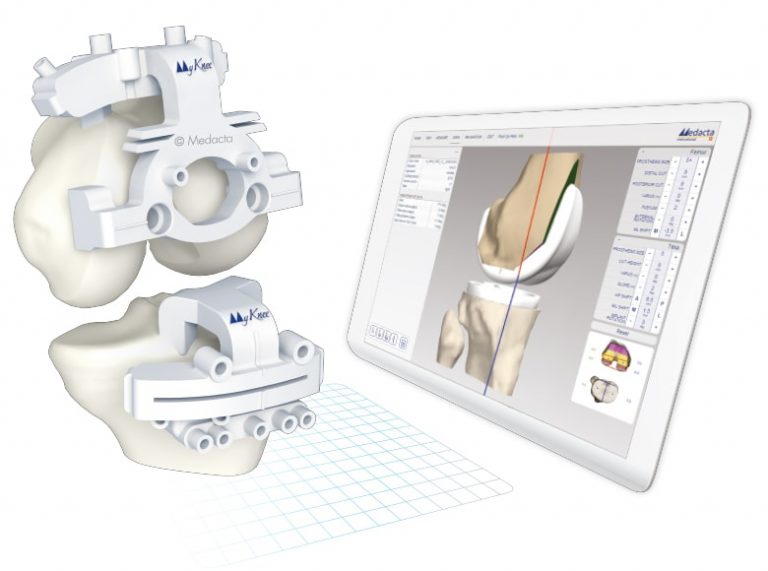
Our approach incorporates 3D-printed patient-specific instruments (PSI), 3D anatomical mapping, augmented reality, and the kinematic alignment (KA) surgical technique. These technologies allow us to tailor each surgery to the individual’s unique anatomy, ensuring optimal implant alignment and the restoration of natural knee motion. By using 3D imaging to accurately map the knee joint, we create customised instruments that enhance the precision and effectiveness of the procedure.

Mr Freedman employs computer-assisted and augmented reality technologies during surgery to provide real-time feedback, which help to achieve optimal placement of the knee implants according to kinematic alignment principles. This personalised approach aligns the knee naturally and improves joint biomechanics, reducing postoperative discomfort and accelerating recovery.

The benefits of a total knee replacement

The advanced technologies and techniques used in our knee replacement procedures have a range of benefits:
  • Tailored Fit for Optimal Function: Our 3D-printed patient-specific instruments and detailed anatomical mapping help achieve precise alignment with your unique anatomy, promoting better joint function and longevity.

  • Advanced Kinematic Alignment: Our kinematic alignment technique aligns the artificial joint to mimic your knee’s natural motion, reducing wear and enhancing comfort, allowing a more active lifestyle post-surgery.

  • Real-Time Precision: Using augmented reality technology during surgery for real-time feedback on implant positioning. This cutting-edge approach increases the accuracy of the procedure, minimises risks, and improves surgical outcomes.

  • Reduced Recovery Time: The precision and efficiency of our surgical techniques not only enhance the surgical outcome but also speed up the recovery process, allowing you to return to daily activities sooner.

  • Durable and Effective: The advanced materials used in our implants help achieve excellent durability and function.

Case Examples

Mr Freedman’s training & experience

An Internationally-trained and renowned Orthopaedic surgeon, Mr Freeman brings over a decade of experience to providing a meticulous standard of care.

The success of technically complicated surgery depends on several elements, but one important factor is having a highly-trained and experienced surgeon.

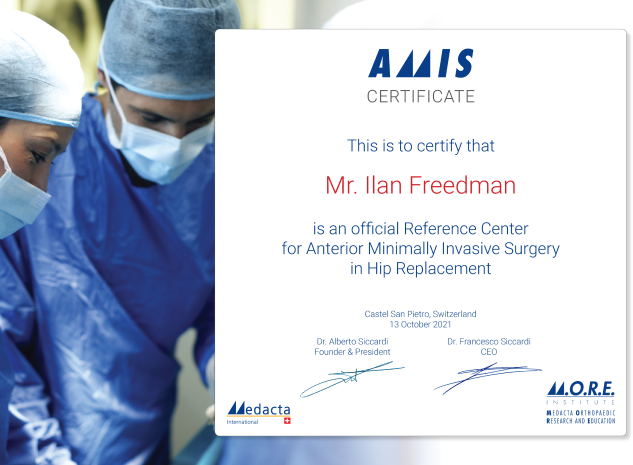
Mr Freedman completed a fellowship in the UK to train in hip arthroscopy with Professor Damian Griffin, a world-renowned expert in hip arthroscopy and hip preservation surgery.

While on fellowship in the UK, Mr Freedman’s supervisor, Professor Griffin, received an invitation to observe a new hip replacement technique in Paris with Dr. Frederic Laude, a world expert in Direct Anterior hip surgery. As fate would have it, other commitments prevented Prof. Griffin from attending, so he sent Mr Freedman in his place, and he was amazed by the innovative procedure, the minimal incision, and the quick recovery of patients. Mr Freedman later returned to Paris to complete a fellowship under Dr Frederic Laude.

Upon returning to Australia, Mr Freedman, successfully implemented anterior approach hip replacements in his practice, leading to rapid growth in his case numbers and the eventual standardisation of this technique, even for complex surgeries.

  • Internationally Trained and Recognised

    Mr Freedman has trained under some of the best hip surgeons in Europe.

  • Cutting-Edge Techniques

    Mr Freedman employs advanced technology and techniques to ensure the best possible outcomes for his patients.

Advanced techniques, fantastic results

The advanced technology and techniques used in our knee replacement procedures helps achieve lasting relief and rapid recovery for our patients.

Frequently asked questions

What are the benefits of a total knee Replacement ?

The purpose of Total Knee Arthroplasty is to significantly reduce the symptoms of arthritis. These include:


  • A rapid and significant reduction of knee pain.
  • Recovery of mobility – your knee will move more smoothly again and will function more normally.
  • Improvement in quality of life – Everyday activities such as walking and bending your knee will no longer be limited by pain and restricted mobility.
There are two types of anaesthesia: (i) General Anaesthetic (where the patient is deeply asleep) and (ii) Regional Anaesthetic (epidural or spinal) where the operative leg is made numb by way of an injection. To gain the “best of both worlds” and provide the most pleasant and safest anaesthetic, our practice often prefers a combination technique in which a patient receives a spinal anaesthetic but also general sedation. This allows our patients to gain all the benefits of a spinal or epidural (less pain, less pain killers, less bleeding during surgery) but also to be sedated and thereby not aware of surgical proceedings while avoiding the need for breathing machines and deep general anaesthetic. Your anaesthetist will talk with you before the procedure to clarify exactly what anaesthetic will be used and the associated recovery after that anaesthesia.
You will first receive an anaesthetic so that the operation can be performed safely and with no pain. This is usually a combination spinal/sedation anaesthetic (see above). An incision of about 12cm is then made over the front of the knee. The main knee tendon (quadriceps and patella tendon) is then moved to the side and the surfaces of the knee joint are then exposed. The edges of the damaged cartilage are cleared and the underlying surfaces are prepared for implantation of the prostheses. Advanced computer technology and patient-specific instruments are utilised to ensure that the implants are positioned accurately. Once the implants are appropriately positioned and fixed in position the incision is carefully closed and your rehabilitation begins. Mr Freedman endeavours to achieve a rapid recovery from surgery. Most of our patients are able to stand as soon as the anaesthetic wears off, commence walking day of surgery and are able to be discharged after 2-3 days in hospital.
Patients with moderate to severe arthritis who cannot adequately manage their symptoms through other non operative means are generally candidates for knee replacement (TKR). Patients are usually encouraged to try simple non-operative measures such as weight loss, simple painkillers and anti-inflammatories, physiotherapy and activity modification before undergoing surgery. By the time patients see a surgeon many have already tried non operative treatment from the general practitioner. If, despite non-operative treatment, you still have a painful and/or stiff knee that interferes with your quality of life and daily activities, you may be a candidate for surgery. To assess your knee Mr Freedman will take a careful clinical history, examine your knee, and study X-rays and other imaging (if required) of your knee assessment of your knee. He may then recommend total knee replacement.
The terminology here is unfortunately confusing for patients!
In knee replacement/resurfacing any remaining worn cartilage and a few mm of bone are removed from the end of the femur (thigh bone) and the top end of the tibia (lower leg) bone. The muscles of the knee and collateral ligaments (side ligaments of the knee) are completely preserved. The worn cartilage is then replaced with a smooth prosthetic surface. The procedure is called a total replacement because all of the cartilage surface of the knee is covered with a new surface. In comparison, in a partial knee replacement only the cartilage on half half (ie. either inside or outside half) of the knee is resurfaced.

Total Knee Arthroplasty involves placing a new surface onto the lower end of the thigh (femur) bone and onto the top end of the tibia (leg bone). In some, but not all cases, a new lining will also be placed on the undersurface of the knee cap (patella). The femoral prosthesis is made of an advanced metal alloy. It has a special groove in it to allow for movement of the knee cap over the front of the knee. The tibial component consists of two parts: a metal prosthesis that is fixed to the tibia and then a sophisticated polyethylene liner that secures into the tibial component. If required, the patella (knee cap) component is also made from polyethylene. There are multiple different implant designs and manufacturers on the market. Mr Freedman uses top-of-the-line implants that are engineered and manufactured to the highest standards in Switzerland. Our usual implant is the Medacta Sphere design but in some situations (e.g. matching to a replacement previously performed on the other knee) a different implant may be suggested. This detail will be discussed at your consultation.
No. Surgeons and anaesthetists have made major advances in recent years in regard to eliminating or at least substantially reducing discomfort from surgery. A “multimodal” (multiple simultaneously combined techniques) will be utilised to turn off pain pathways prior to surgery and to then keep you comfortable during your recovery. You may still experience some mild discomfort but our patients can generally stand and walk within hours of surgery and usually report that any discomfort is very manageable and that the procedure is very well tolerated.

Our locations

Our main practice consulting rooms are located at:

Mr Ilan Freedman

Suite 2, Monash House Private Hospital
271 Clayton Road, Clayton VIC 3168.

Driving:  Monash House Private Hospital is situated on Clayton Rd,  across the road from Monash Medical Clinic. Clayton Road is easily accessible form Princes Highway (Dandenong Rd, North Rd or Centre Rd).

Parking:  Parking available onsite (paid – inexpensive) and neighbouring streets (free)

Public transport:  3 minutes walk from Clayton Railway Station.  Bus stop directly outside.

Location in the hospital: We are located on the ground floor,  opposite the hospital coffee shop and next door to Capital Radiology

Mr Freedman also consults regularly at the following clinics.  


Mulgrave Private Hospital Consulting Suites

Address: Blanton Dr, Mulgrave VIC 3170


Parking: Inexpensive onsite parking

The Bays Private Hospital Consulting Suites – Mornington

Address: Vale St, Mornington, 3931


Parking: Free Parking Available on site

Location: We are located in Suite 15 at The Bays.

Warragul

Address: 33 Victoria Street, Warragul 3820

Parking: Free Street Parking

Maryvale Private Hospital

Address: 286 Maryvale Rd, Morwell, 3840

Parking: Free Street Parking

Bay Street Specialist Centre

Address: Suite 4, 214 Bay Street, Brighton VIC 3186

Parking: Free Street Parking

Mr Freedman’s surgery operating locations are:

Mulgrave Private Hospital

Address: Cnr Police Rd & Gladstone Rd, Mulgrave, 3170

The Bays Private Hospital, Mornington

Address: 262 Main St, Mornington VIC 3931

Monash House Private Hospital

Address: 271 Clayton Rd, Clayton VIC 3168

Maryvale Private Hospital

Address: 286 Maryvale Rd, Morwell VIC 3840

Telehealth Consultation

We are pleased to offer telehealth appointments, allowing you to consult with Mr Freedman from the comfort of your home. Whether for a follow-up, pre-surgical consultation, or orthopaedic advice, our telehealth services provide expert care without the need to travel. Using secure and easy-to-use technology, our telehealth appointments fit seamlessly into your schedule, ensuring the same high standard of care as an in-person visit.

telehealth (1)

Get back to life sooner

We understand that seeking care for your hip or knee condition is an important decision, and we are here to provide you with the support and expertise you need.

Please take a moment to fill out the following information so that we can better understand your needs and how we can assist you.

This field is for validation purposes and should be left unchanged.